SUMMITExterior Solutions

Placer County, California

ServicesConcrete cleaning

Driveway and concrete cleaning in Roseville and Placer County — even passes, no wand stripes, stains treated on their own.


Most of the gray on a driveway is surface buildup — algae, tire film, dust, leaf tannin — and it lifts. What does not lift is what soaked in: oil, rust, etching. The method changes with the surface, because a broom-finish slab, a stamped patio and an exposed-aggregate walk are three different materials that happen to be the same color, and the wrong one on any of them is permanent.

01How it's done

Treat the stains first, then clean the whole surface evenly.


  1. 01The concrete is photographed as found, stain by stain, and any existing sealer is noted — worn, whitened or intact — before anything is applied.
  2. 02A drain survey comes first: we work out where the wash water will travel before a hose comes off the truck. Beds and lawn beside the slab are pre-wet.
  3. 03Oil is degreased as its own step, in its own tank, before the cleaning mix goes down — never mixed into it. It gets time to work, agitation, and a thorough rinse.
  4. 04Rust from irrigation, fertilizer or clay is treated with a stain-specific product, test-spotted first so you see how far it lifts before the whole area is done.
  5. 05The cleaning mix goes across the whole surface and is given its dwell. On stamped and aggregate concrete it is repeated rather than answered with more pressure.
  6. 06The surface is cleaned by the method it can take — even overlapping passes on broom finish, a low-pressure rinse on stamped and aggregate — so the finish is uniform, with no wand stripes.
  7. 07Edges, borders and expansion joints are detailed, the landscaping is rinsed, and the finished slab is photographed.
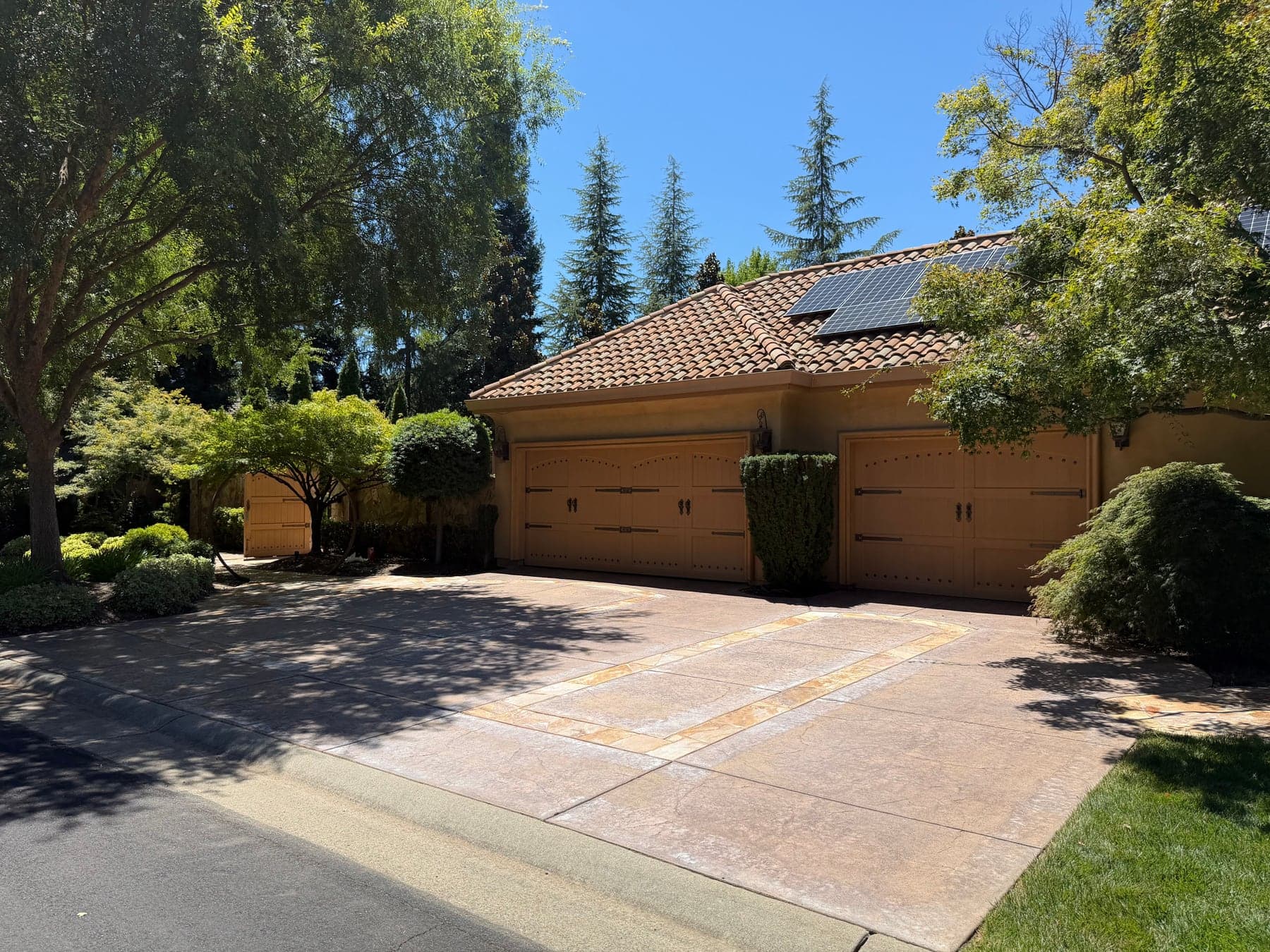
Stamped concrete driveway in front of a three-car garage after cleaning — even color across the surface, borders intact
Stamped concrete driveway · after cleaning. Chemistry, dwell and a low-pressure rinse — the clear coat stays.
02By surface

Three concretes, three methods.

Standard broom-finish concrete

Pre-treated with the cleaning mix, given its dwell, then cleaned with a surface cleaner in overlapping passes so the finish is even — no wand stripes, no zebra driveway. Edges, borders and expansion joints are detailed with the wand. If staining remains, the chemistry goes on again before anything else does.

Stamped and stained concrete

Chemistry, dwell and a low-pressure rinse — and nothing else. A surface cleaner or a high-pressure wand strips the clear coat that gives stamped concrete its color and sheen, so neither goes near it. The mix does the work and the water carries away what it released.

Exposed aggregate

Treated the same way as stamped concrete, for a different reason: the stones sit in a cement paste that was deliberately eroded to expose them, and high pressure washes out what is left. Once a stone is out it does not go back. Chemistry twice beats pressure once, and staining in the texture between the stones is set as an expectation, not a promise.

Pavers, patios, pool decks and walls

Pavers are cleaned at low pressure in even passes so the joint sand stays put. Patios and pool decks get the slip-risk growth taken off with the same care for any sealer that is on them. Retaining walls are cleaned with the runoff below the wall planned first, because that is the job.

03Stains

Each stain is its own job, before the main clean.


Degreasing happens as a separate step, in a separate tank, before the cleaning mix — never in the same batch. Oil is treated, allowed to dwell, agitated and rinsed thoroughly; then the whole surface is cleaned. Rust from irrigation, fertilizer and clay is treated with a stain-specific product, test-spotted first, and we point out where it is coming from — usually a sprinkler head — so the cause can be fixed.

Tire marks, leaf tannin and algae are surface stains and lift with the clean. Oil that soaked into the pores years ago, rust that oxidized in place and etching from acid or fertilizer are in the material. Those lighten as far as the surface allows, and your written quote says which is which before you decide.

04From the field
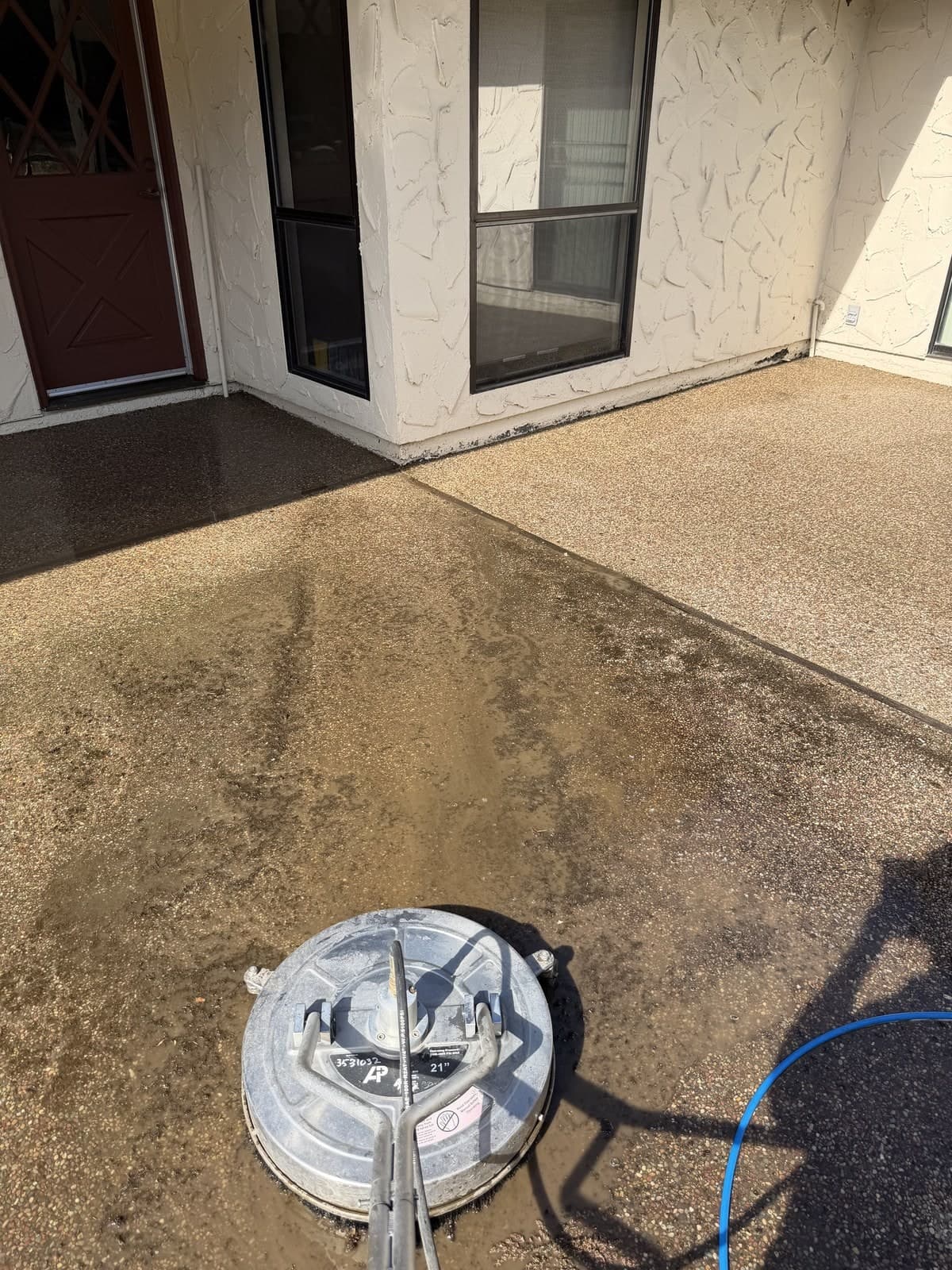
Concrete mid-job: a hard line between the cleaned surface and the grime still ahead of it
Concrete · mid-job, one frame. What one pass removes.
05The honest part

What we will tell you before we start, not after.


Embedded stains lighten, they don't vanish. Deep-set oil, rust that has oxidized in place and etching are in the concrete — we show you on a test spot before we quote the whole surface.

Freshly cleaned concrete can reveal marks the grime was hiding — old sealer lines, patch edges, sprinkler shadows. They were always there. The assessment flags them ahead of time so cleaning day holds no surprises.

Existing sealer is noted in your report as we find it — worn, whitened or intact — so you know what the surface has on it before any cleaning starts.

Your landscaping and propertyBeds and lawn beside the concrete are pre-wet before the mix goes down and rinsed after, and we work out where the wash water will travel before a hose comes off the truck.

06Questions people ask
Does pressure washing damage concrete?

Done wrong, yes — a wand held too close or too long burnishes and stripes a slab permanently, strips the clear coat off stamped concrete and washes stones out of aggregate. That is why the method changes by surface and why the chemistry is asked to do the work first.

Will washing damage stamped concrete or remove the sealer?

Not the way we do it. Stamped concrete gets chemistry, dwell and a low-pressure rinse only — no surface cleaner, no high-pressure wand. A sealer that is already failing will show its condition once the grime is off, and we note that in the report.

How do you remove oil stains from a driveway?

As a separate step before the main clean: a degreaser on the stain, time to work, agitation, a thorough rinse — then the whole surface is cleaned. Fresh oil lifts. Oil that has soaked in for years lightens, and we test a spot so you see how far before you decide.

Do tire marks come out?

Usually, yes — tire marks are rubber and road film sitting on the surface, and they lift with the clean. Marks that have baked in over a hot summer can take a second pass of chemistry.

How often should a driveway be cleaned?

Shaded slabs and anything under trees grow algae faster and get slippery sooner than a slab in full sun. The assessment tells you where yours sits.

07In writing

Our guarantee


If we cleaned it and didn’t get it right — a missed spot, bad prep, something we forgot — we come back and fix it. No charge, and no time limit on that.

What we can’t promise is to remove what isn’t dirt. Permanent staining, oxidation, rust pitting and etching are in the material itself, not on top of it. We’ll tell you which is which before we start, not after.

08Where we do this

Concrete cleaning across Placer County, plus Folsom. See what we notice in Roseville, Granite Bay, Loomis and Lincoln — or across every city we serve.

Not sure what your property needs? That’s what the assessment is for.

We’ll personally follow up within 1–2 business days.